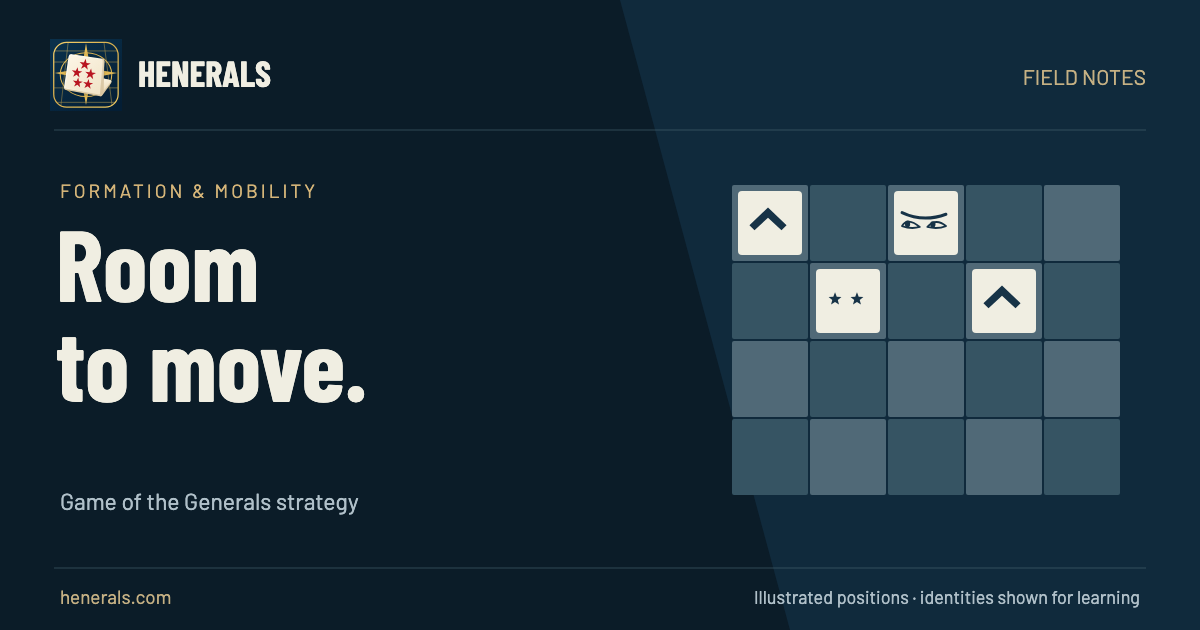
All 21 pieces begin inside three home rows, but six squares stay empty. Those gaps are not decoration. They are the joints of the formation: the places that let a crowded army turn, exchange lanes, and respond after the first challenge.
Trace two exits
Before confirming a setup, choose two front pieces and trace an orthogonal route for each. If both need the same empty square, the formation has only one working hinge. Move one gap sideways or bring a different piece to the front.
Break the wall
A solid front row looks protected but often blocks the second row. An alternating edge gives several pieces a legal first move while keeping their identities ambiguous. It also reduces the cost of a single failed challenge.
Test the flag lane last
The flag needs safety now and a route later. Once the rest of the formation can breathe, check that one rearrangement opens a path toward the far rank. A flag that can never leave its bunker gives away its strategic future even while its identity stays hidden.